What Is Brightness, Really? A TFT Display Deep Dive
Insights · 1 October 2026 · 7 min read · By Pratik Jhunjhunwala

Understanding nits, uniformity, and why the backlight works so much harder than the spec sheet suggests.
Walk outside with a phone or handheld device on a sunny day and some screens stay perfectly readable while others all but disappear into a dim, washed-out rectangle. That difference comes down to brightness — and for anyone specifying a panel through a TFT display supplier for an outdoor kiosk, vehicle display, or handheld instrument, it's a spec that can make or break usability in the field.
As a display manufacturer working with TFT-LCD technology every day, BIBA Electronics fields brightness questions constantly from engineers designing products that have to work in bright environments. Here's the breakdown: what brightness actually measures, how it's specified, and why the backlight inside a panel has to work far harder than the number on the datasheet implies.
The Short Answer
Brightness, more precisely called luminance, is the intensity of light coming off a display's surface. It's measured in candela per square meter (cd/m²), a unit almost everyone in the display industry just calls nits. A typical laptop screen runs around 250–300 nits; a phone built for outdoor use might push 800 nits or more; a display designed to stay legible in direct sunlight can exceed 1,000 nits.
Higher nits means a display can hold its own against ambient light. Lower nits is fine indoors, but the same panel can wash out completely outdoors.
How Brightness Is Measured
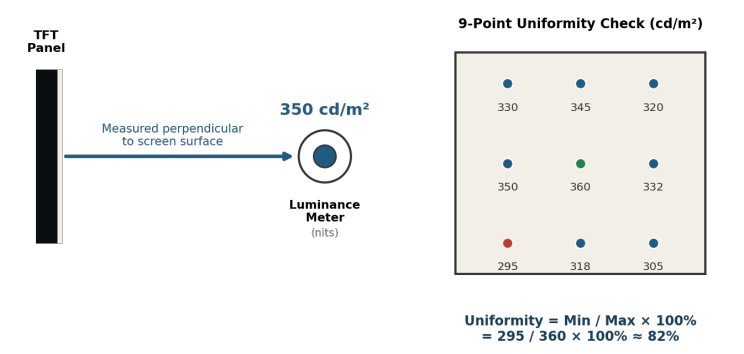
Manufacturers measure luminance with a photometer or luminance meter, held perpendicular to the screen, while the panel displays a full white test pattern at maximum backlight output. The single number on a datasheet is usually the luminance measured at the center of the panel under these standard conditions.
But a single center-point reading doesn't capture the whole picture, because backlights don't always distribute light perfectly evenly. That's where brightness uniformity comes in — typically measured at nine points spread across the panel:
Uniformity = (L(min) / L(max)) × 100%
In the example below, nine measurement points range from 295 to 360 cd/m², giving a uniformity of roughly 82% — a healthy result for most applications. Lower uniformity shows up as visibly dimmer corners or edges on a supposedly uniform white screen.
Why the Backlight Works So Much Harder Than the Spec Implies
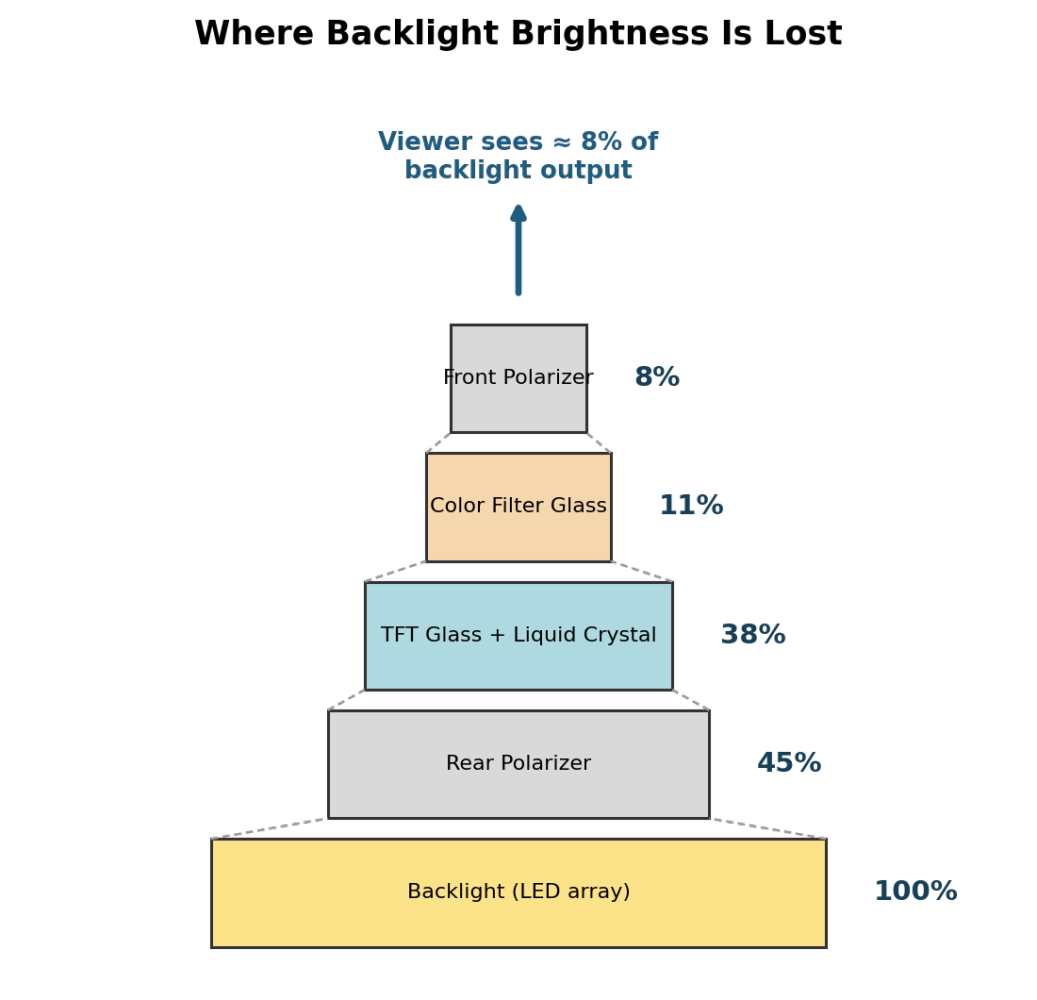
Here's the part that surprises a lot of engineers: a panel rated at, say, 350 nits does not have a backlight that only outputs 350 nits worth of light. The backlight has to produce far more than that, because most of its light never reaches the viewer at all.
Light from the backlight has to pass through several layers before it escapes the front of the panel — a rear polarizer, the TFT glass and liquid crystal layer, a color filter, and a front polarizer. Each of those layers absorbs or blocks a portion of the light:
- Polarizers each block roughly half the light passing through, since they only allow one polarization orientation through.
- The liquid crystal layer adds further loss, even in its most transparent (white) state.
- The color filter is the biggest loss of all — each pixel's red, green, or blue filter absorbs most wavelengths that don't match its own color.
By the time light makes it all the way through the stack, only a small fraction of the original backlight output reaches the viewer's eyes — often somewhere around 5 to 10%. That's why backlight units are engineered to be dramatically brighter than the panel's final rated brightness.
Brightness by Application
How bright a panel needs to be depends entirely on where it's going to be viewed. The table below summarizes typical brightness ranges by use case — actual specs vary by manufacturer and backlight design, so always check the datasheet from your TFT display supplier for exact figures.
| Application | Typical Brightness | Notes |
|---|---|---|
| Standard Indoor | 250 – 350 nits | Office, consumer electronics, indoor kiosks |
| High-Brightness Outdoor | 700 – 1,000 nits | Vehicle displays, shaded outdoor use, industrial HMIs |
| Sunlight-Readable | 1,000 – 1,500+ nits | Direct sun exposure, often paired with transflective or anti-glare optics |
Pushing brightness higher isn't free — a stronger backlight draws more power and generates more heat, both of which matter for battery-powered or sealed enclosure designs. Specifying brightness usually means balancing readability against power budget and thermal limits, not just chasing the highest nits number available.
Specifying a Display for Bright or Outdoor Environments?
BIBA Electronics designs and supplies custom TFT-LCD and TFT display solutions across standard, high-brightness, and sunlight-readable configurations, with full datasheets covering brightness, uniformity, contrast ratio, and viewing angle for every part we ship. As a dedicated TFT display manufacturer and supplier, we help engineering teams balance brightness against power consumption and thermal constraints for the environment the product will actually live in. Talk to our team about your display requirement.
Wrapping Up
Brightness looks like a simple number on a spec sheet, but it represents the end result of a backlight working far harder than that number suggests, pushing light through layer after layer of polarizers, liquid crystal, and color filters that absorb most of it along the way. Understanding that loss is what makes sense of why sunlight-readable displays need such powerful, power-hungry backlights in the first place.
Next time you're specifying a display through a TFT display manufacturer, remember: think about where the product will actually be used, check uniformity alongside the headline nits figure, and weigh brightness against the power and thermal budget you actually have to work with.
Frequently Asked Questions
What is brightness in a TFT display?
Brightness, more precisely called luminance, is the intensity of light emitted from a display's surface. It is measured in candela per square meter (cd/m²), commonly referred to as nits, using a luminance meter held perpendicular to the screen.
What is brightness uniformity?
Brightness uniformity describes how evenly luminance is distributed across a display's surface. It is typically calculated by measuring luminance at several points (often nine) across a full white screen and dividing the minimum reading by the maximum reading, expressed as a percentage.
Why does a TFT-LCD backlight need to be much brighter than the display's rated brightness?
Light from the backlight passes through several layers — polarizers, the liquid crystal layer, and color filters — each of which absorbs or blocks a portion of it. By the time light reaches the viewer, only a small fraction of the original backlight output remains, often around 5 to 10 percent, so the backlight itself must be driven far brighter than the panel's final rated luminance.
How bright does a display need to be for outdoor or sunlight readability?
Standard indoor TFT displays are typically rated around 250 to 350 nits, which is not enough to overcome direct sunlight. Outdoor or sunlight-readable displays generally need 700 nits or more, with many transflective or high-brightness designs reaching 1,000 to 1,500 nits or higher.
Related Reading
- What Is Contrast Ratio, Really? A TFT Display Deep Dive
- What Is Viewing Angle, Really? A TFT Display Deep Dive
- What Is Optical Response Time, Really? A TFT Display Deep Dive
About BIBA Electronics: BIBA Electronics is a TFT display manufacturer and TFT display supplier providing custom LCD and TFT panel solutions, technical datasheets, and engineering support for OEM and product design teams.
BIBA Electronics: electronics manufacturing, TFT displays and embedded design in Gurugram, India.