What Is Contrast Ratio, Really? A TFT Display Deep Dive
Insights · 1 October 2026 · 7 min read · By Pratik Jhunjhunwala

Understanding the formula, the physics, and the panel types behind one of the most important display specs.
Pick up two phones, two monitors, or two TVs and put them side by side, and one thing usually jumps out immediately: one screen looks "punchier" than the other. The colors feel deeper, the shadows feel darker, the whole image just has more pop. Nine times out of ten, what you're reacting to is contrast ratio — and if you're sourcing panels from a TFT display supplier or specifying a display for your own product, it's one of those specs that sounds simple but hides a surprising amount of physics underneath.
As a display manufacturer working with TFT-LCD technology every day, BIBA Electronics gets contrast ratio questions from engineers and product teams constantly. Here's the breakdown: what contrast ratio means, the math behind it, and why it's such a tricky number for TFT-LCD panels specifically.
The Short Answer
Contrast ratio (CR) is the ratio between the brightest white a screen can produce and the darkest black it can produce. That's it conceptually. The bigger the gap between those two extremes, the more "contrast" the image has — brighter highlights, deeper shadows, and more perceived depth.
A display with a 1000:1 contrast ratio can make its white state 1,000 times brighter than its black state. A display with 5000:1 stretches that gap even further. Higher is generally better, but as we'll see, the number alone doesn't tell the whole story.
The Contrast Ratio Formula
The static contrast ratio is calculated as:
CR = L(white) / L(black)
Where:
- L(white) is the luminance of a full white screen, measured in cd/m² (also called nits)
- L(black) is the luminance of a full black screen, in the same units
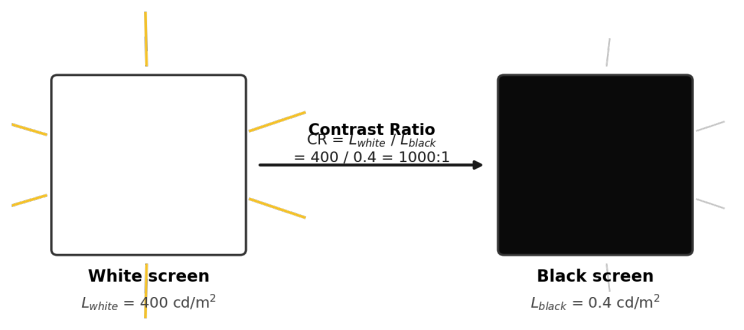
So if a TFT panel measures 400 cd/m² at full white and 0.4 cd/m² at full black, the math is straightforward:
CR = 400 / 0.4 = 1000:1
That's exactly the scenario illustrated below — two screens, two luminance readings, one ratio.
Simple enough on paper. The interesting part is why that black luminance value is never zero on a TFT-LCD panel — and that comes down to how the display actually works.
Why TFT-LCD Screens Struggle to Go Truly Black
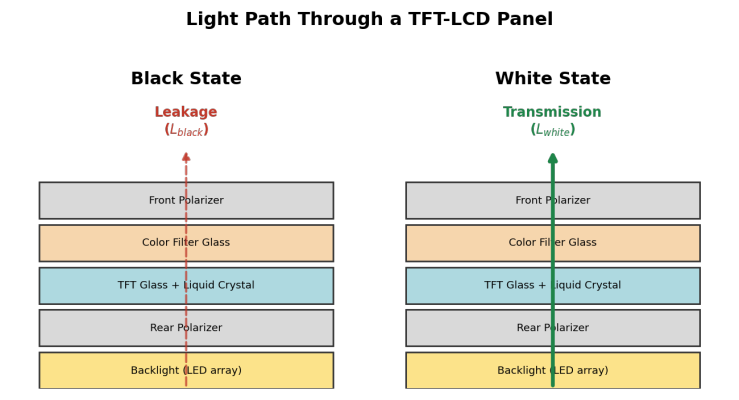
Here's the thing most people don't realize about LCD technology: the pixels don't make their own light. A TFT-LCD panel has a backlight running underneath the whole screen, on constantly, regardless of what's being displayed. To create an image, a layer of liquid crystal material twists and untwists to either block or pass that backlight through a pair of crossed polarizing filters.
- In the white state, the liquid crystal lets light pass through largely unobstructed.
- In the black state, the liquid crystal tries to block the light entirely — but it can't. Some photons always sneak through the imperfect alignment of the crystals and polarizers.
That small but unavoidable leak is what sets the panel's black luminance, and it's the single biggest limiting factor on contrast ratio for any TFT-LCD display. This is also the core reason OLED screens — which switch individual pixels off completely — can claim near-infinite contrast ratios. There's no backlight to leak through in the first place.
The diagram below shows both states side by side: notice the dashed "leakage" arrow on the left versus the solid "transmission" arrow on the right.
Static vs. Dynamic Contrast Ratio
If you've ever browsed display spec sheets from different TFT display suppliers, you've probably seen two very different numbers thrown around for similar-looking panels — one modest (say, 1000:1) and one enormous (say, 5,000,000:1). That gap usually comes down to which contrast ratio is being measured.
- Static contrast ratio is what we calculated above: white luminance versus black luminance, measured on the same image, at the same backlight setting.
- Dynamic contrast ratio measures the brightest white the panel can hit at full backlight power against the darkest black it can hit with the backlight dimmed down for a dark scene.
CR(dynamic) = L(white, max) / L(black, min)
Because the backlight itself is changing brightness between the two measurements, dynamic contrast ratio numbers can look dramatically higher — but they don't reflect what's happening within a single static image the way the static ratio does. When comparing displays or evaluating quotes from a display manufacturer, the static number is the more honest, apples-to-apples figure.
How TFT Panel Types Compare
Not all TFT-LCD panels leak light equally. The specific way the liquid crystal molecules are aligned — the panel type — has a direct effect on how dark the black state can actually get, which is why panel selection matters when working with any TFT display supplier.
| Panel Type | Typical Static CR | Black-Level Behavior |
|---|---|---|
| TN | 600:1 – 1,000:1 | Highest leakage, fastest response time |
| IPS | 700:1 – 1,200:1 | Wide viewing angles, moderate leakage |
| VA | 3,000:1 – 6,000:1 | Tightest crystal alignment, deepest LCD blacks |
VA (Vertical Alignment) panels consistently post the highest native contrast ratios among LCD types because their crystal structure blocks light more thoroughly in the off-state. IPS panels trade some of that black depth for better color consistency and viewing angles, while TN panels prioritize speed over either.
Sourcing TFT Displays for Your Product?
BIBA Electronics designs and supplies custom TFT-LCD and TFT display solutions across TN, IPS, and VA panel technologies, with full datasheets covering contrast ratio, optical characteristics, and electrical specifications for every part we ship. As a dedicated TFT display manufacturer and supplier, we help engineering teams choose the right panel for their brightness, viewing-angle, and contrast requirements — not just the highest number on a spec sheet. Talk to our team about your display requirement.
Wrapping Up
Contrast ratio looks like a single, simple number — but behind it is a real physical limitation rooted in how TFT-LCD panels are built. Because the backlight never truly turns off, some light leakage is unavoidable, and that leakage is what separates a TN panel's modest contrast from a VA panel's noticeably deeper blacks.
Next time you're comparing display specs from any TFT display manufacturer, remember: it's not just about the headline ratio. It's about understanding whether you're looking at a static or dynamic number, and what panel technology is doing underneath to produce it.
Frequently Asked Questions
What is contrast ratio in a TFT display?
Contrast ratio is the ratio between the luminance of a full white screen and the luminance of a full black screen on the same display, expressed as a value like 1000:1.
Why can't TFT-LCD panels produce a perfect black?
TFT-LCD panels use a constantly-on backlight and a liquid crystal layer to block or pass that light. The liquid crystal and polarizers can never block 100% of the backlight, so a small amount always leaks through in the black state, limiting contrast ratio.
Which TFT-LCD panel type has the highest contrast ratio?
VA (Vertical Alignment) panels typically have the highest static contrast ratio among TFT-LCD types, often in the 3,000:1 to 6,000:1 range, because their crystal alignment blocks backlight more completely than TN or IPS panels.
What's the difference between static and dynamic contrast ratio?
Static contrast ratio compares white and black luminance on the same image at a fixed backlight level. Dynamic contrast ratio compares the brightest white at full backlight power to the darkest black with the backlight dimmed, which produces much larger marketing numbers.
Related Reading
- What Is Viewing Angle, Really? A TFT Display Deep Dive
- What Is Optical Response Time, Really? A TFT Display Deep Dive
- What Is Brightness, Really? A TFT Display Deep Dive
About BIBA Electronics: BIBA Electronics is a TFT display manufacturer and TFT display supplier providing custom LCD and TFT panel solutions, technical datasheets, and engineering support for OEM and product design teams.
BIBA Electronics: electronics manufacturing, TFT displays and embedded design in Gurugram, India.