What Is Viewing Angle, Really? A TFT Display Deep Dive
Insights · 1 October 2026 · 7 min read · By Pratik Jhunjhunwala
Understanding how off-axis viewing affects contrast, color, and image quality on TFT-LCD panels.
Tilt a laptop screen back just a little, or glance at a kiosk display from the side, and the image can shift fast — colors wash out, blacks turn gray, and contrast collapses. What you're running into is the limits of the display's viewing angle, and for anyone specifying a panel through a TFT display supplier, it's one of the specs that matters just as much as brightness or resolution, especially for kiosks, instrument clusters, and any product viewed from multiple positions.
As a display manufacturer working with TFT-LCD technology every day, BIBA Electronics fields viewing angle questions constantly from engineers designing products that get viewed off-axis. Here's the breakdown: what viewing angle means, how it's actually measured, and why panel type makes such a big difference.
The Short Answer
Viewing angle is the maximum angle, measured from a line perpendicular to the screen (the "normal"), at which a display can still be viewed with acceptable image quality before contrast and color shift too far. Look straight at a screen and you get the panel's best performance. Move off to the side, above, or below, and at some point the image degrades enough that it's no longer considered usable.
That usability cutoff isn't arbitrary — it's tied directly back to contrast ratio, which is what makes viewing angle and contrast ratio two sides of the same coin.
How Viewing Angle Is Measured
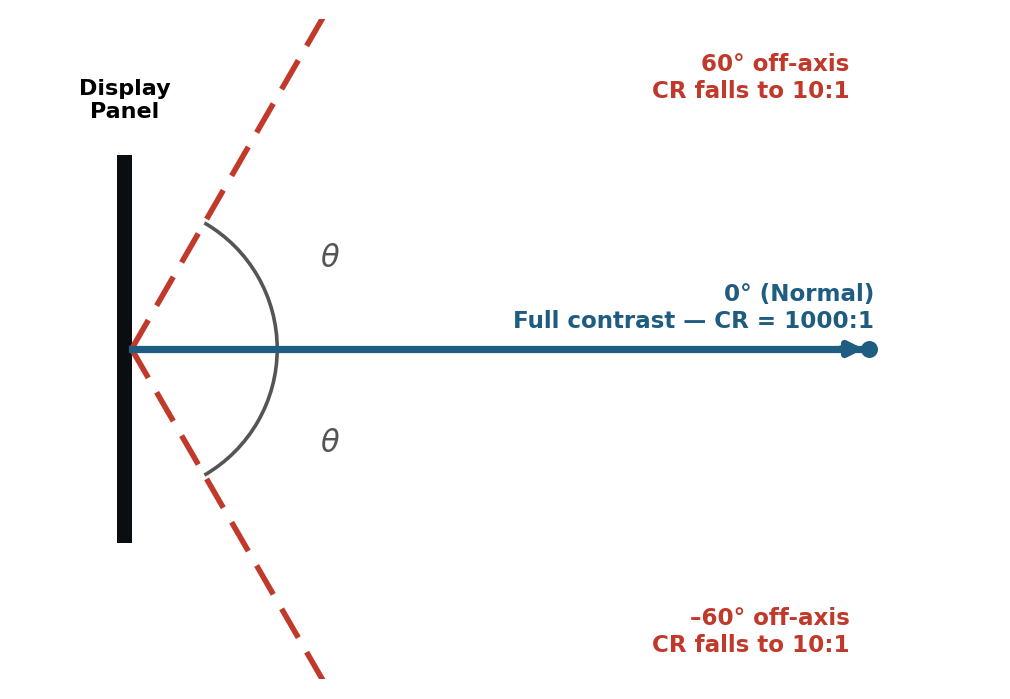
The display industry's standard convention defines viewing angle as the angle at which contrast ratio falls to a threshold of 10:1:
Viewing Angle = θ, where CR(θ) = 10:1
Manufacturers measure this in two directions:
- Horizontal viewing angle — measured left and right of normal, often reported as a total: ΦH = θ(left) + θ(right)
- Vertical viewing angle — measured up and down of normal: ΦV = θ(up) + θ(down)
So a panel rated at ±60° horizontally maintains a contrast ratio of at least 10:1 anywhere within 60 degrees of straight-on, in either direction — a total horizontal viewing angle of 120°. Some datasheets also reference a secondary color-shift criterion (Δu′v′ in the CIE 1976 chromaticity scale) alongside the contrast threshold, since color can shift even where contrast technically holds up.
Simple enough as a measurement convention. The interesting part is why contrast and color shift at all when you move off-axis — and that comes down to the same liquid crystal layer responsible for contrast ratio in the first place.
Why TFT-LCD Panels Have Limited Viewing Angles
A TFT-LCD panel creates an image by twisting liquid crystal molecules to control how much backlight passes through to the viewer. That control works best along one specific path: straight through the panel, perpendicular to the glass. Looked at off-axis, light travels through the liquid crystal layer at an angle instead, passing through a different effective thickness and orientation of crystal than it would head-on.
That changed path alters how the light is polarized by the time it reaches the front polarizer, which shifts both contrast (more backlight leaks through in the black state) and color (different wavelengths are affected unevenly). The wider the viewing angle a panel can tolerate, the better its liquid crystal alignment manages this off-axis distortion.
This is exactly where panel type matters most. The way the crystal molecules are aligned at rest determines how much an off-axis viewing path disrupts that alignment:
- TN (Twisted Nematic) panels twist crystals vertically through the cell, which makes the off-axis light path change dramatically with angle — the reason TN panels have the narrowest, most asymmetric viewing angles.
- IPS (In-Plane Switching) panels align crystals parallel to the glass plane and rotate them within that plane, so the effective path stays far more consistent at an angle — giving IPS panels wide, symmetric viewing angles.
- VA (Vertical Alignment) panels align crystals vertically when off, which delivers deep blacks on-axis but can introduce more noticeable contrast and color shift off-axis than IPS, despite a wide rated angle.
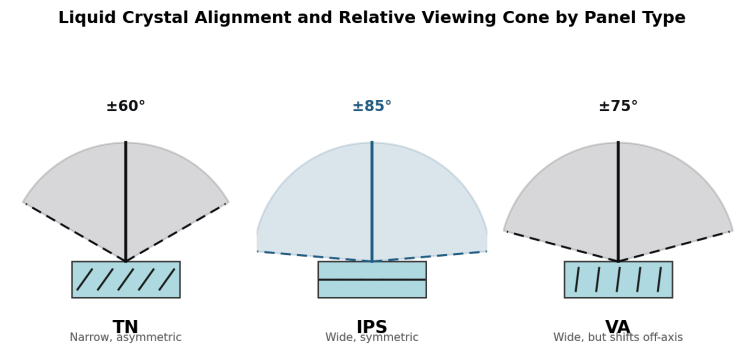
Viewing Angle by Panel Type
Not all TFT-LCD panels handle off-axis viewing equally. The table below summarizes typical total viewing angle ranges — actual specs vary by manufacturer and model, so always check the datasheet from your TFT display supplier for the exact figures.
| Panel Type | Typical Viewing Angle | Off-Axis Behavior |
|---|---|---|
| TN | 90° – 120° total | Narrow, asymmetric — shifts quickly, especially vertically |
| IPS | 160° – 178° total | Wide and symmetric, minimal color shift |
| VA | 140° – 170° total | Wide, but more contrast/color shift off-axis than IPS |
IPS panels consistently lead on viewing angle because their in-plane crystal rotation keeps the optical path more uniform across angles. TN panels trade viewing angle for speed and cost, while VA panels land in between — wide angles on paper, with the caveat that contrast and color hold up less evenly off-axis than IPS.
Designing a Product That Gets Viewed Off-Axis?
BIBA Electronics designs and supplies custom TFT-LCD and TFT display solutions across TN, IPS, and VA panel technologies, with full datasheets covering viewing angle, contrast ratio, and optical characteristics for every part we ship. As a dedicated TFT display manufacturer and supplier, we help engineering teams choose the right panel technology for kiosks, instrument panels, handheld devices, and any application where the screen won't always be viewed head-on. Talk to our team about your display requirement.
Wrapping Up
Viewing angle looks like a single number on a spec sheet, but it's really a description of how gracefully a panel's liquid crystal layer handles light arriving from an angle instead of straight on. Because TN, IPS, and VA panels align their crystals differently, they each trade off viewing angle, contrast, color accuracy, and response time in different ways.
Next time you're specifying a display through a TFT display manufacturer, remember: it's not just the headline angle that matters. It's whether your product is actually going to be viewed off-axis often enough for that number to matter at all.
Frequently Asked Questions
What is viewing angle in a TFT display?
Viewing angle is the maximum angle, measured from the line perpendicular to the screen, at which a display can be viewed before contrast and color degrade beyond an acceptable threshold, typically defined as the point where contrast ratio falls to 10:1.
Why do TN panels have narrow viewing angles?
TN (Twisted Nematic) panels align liquid crystal molecules in a twisted, vertically tilted structure. Viewed off-axis, light travels through a different effective thickness of liquid crystal, which shifts contrast and color quickly compared to in-plane alignments like IPS.
What does CR ≥ 10:1 mean for viewing angle?
It is the industry convention for specifying viewing angle: the angle, left/right and up/down from the screen's normal, at which the contrast ratio of the display has dropped to 10:1. Angles within that range are considered to have acceptable image quality.
Which TFT-LCD panel type has the widest viewing angle?
IPS (In-Plane Switching) panels typically offer the widest, most symmetric viewing angles among TFT-LCD types, often exceeding 170 degrees, because their liquid crystal molecules stay aligned parallel to the glass plane regardless of viewing direction.
Related Reading
- What Is Contrast Ratio, Really? A TFT Display Deep Dive
- What Is Optical Response Time, Really? A TFT Display Deep Dive
- What Is Brightness, Really? A TFT Display Deep Dive
About BIBA Electronics: BIBA Electronics is a TFT display manufacturer and TFT display supplier providing custom LCD and TFT panel solutions, technical datasheets, and engineering support for OEM and product design teams.
BIBA Electronics: electronics manufacturing, TFT displays and embedded design in Gurugram, India.