What Is Optical Response Time, Really? A TFT Display Deep Dive
Insights · 1 October 2026 · 7 min read · By Pratik Jhunjhunwala
Understanding rise time, fall time, and why some screens handle motion better than others.
Ever notice a faint trail behind a moving cursor, a blurred edge on a scrolling list, or smearing in a fast video on certain screens? That's optical response time showing up in real life. For anyone specifying a panel through a TFT display supplier for a product with motion, video, or fast-changing data, response time can matter just as much as resolution or brightness.
As a display manufacturer working with TFT-LCD technology every day, BIBA Electronics gets response time questions from engineers building everything from industrial HMIs to handheld scanners. Here's the breakdown: what response time actually measures, the math behind it, and why panel type changes the result so much.
The Short Answer
Optical response time is how long a liquid crystal pixel takes to switch from one brightness level to another. It's not instantaneous — unlike OLED, where individual pixels switch electronically, a TFT-LCD pixel has to physically reorient liquid crystal molecules to let more or less backlight through. That physical movement takes time, and the faster it happens, the better a panel keeps up with motion.
A panel with a 5 ms response time updates noticeably crisper than one rated at 15 ms. Slower panels are more prone to motion blur and ghosting, especially in fast video or scrolling content.
The Response Time Formula
Response time is conventionally measured as the sum of two parts:
Response Time = Tr + Tf
Where:
- Tr (rise time) is the time for luminance to climb from 10% to 90% after a pixel is switched from black to white
- Tf (fall time) is the time for luminance to drop from 90% to 10% after a pixel is switched back from white to black
In the example below, a pixel takes about 4.8 ms to rise and 6.6 ms to fall, for a total response time of roughly 11.4 ms — a useful illustration of how the rise and fall stages combine into the number on a spec sheet.
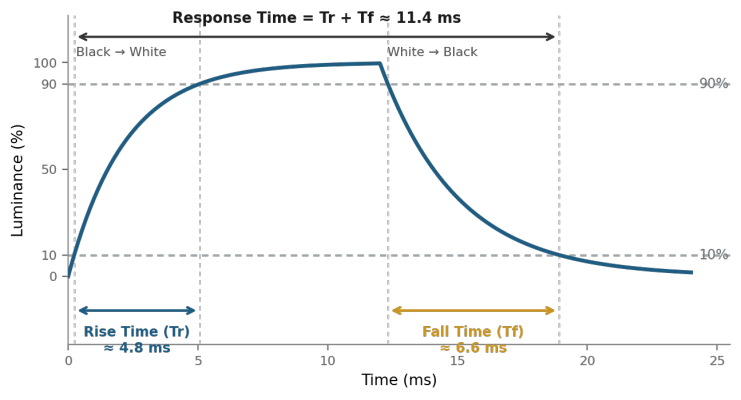
That's the classic black-white-black (BWB) method. Many modern datasheets instead report gray-to-gray (GtG) response time, which averages switching speed across a range of intermediate gray-level transitions rather than a single full swing. GtG numbers tend to be more representative of real video and UI content, since most on-screen changes aren't full black-to-white jumps.
Why TFT-LCD Pixels Take Time to Switch
A TFT-LCD pixel doesn't change brightness instantly because nothing physical happens instantly. Applying or removing a voltage causes the liquid crystal molecules inside the cell to rotate into a new orientation, and that rotation is governed by the crystal's viscosity and its elastic restoring force — the same forces that make thick honey flow slower than water.
- Rise time is driven actively: an applied voltage forces the molecules to rotate, so it tends to be the faster of the two stages.
- Fall time often relies more on the crystal relaxing back on its own once voltage is removed, which is typically slower — this is why fall time, not rise time, is usually the bigger contributor to visible smearing.
Panel type changes how quickly that rotation happens, because each LC alignment has a different rotational path and restoring mechanism:
- TN (Twisted Nematic) panels use the simplest liquid crystal twist, which rotates quickly and gives TN the fastest response times of the common panel types.
- IPS (In-Plane Switching) panels rotate crystals within the glass plane for better color and viewing angle, at some cost to switching speed compared to TN — though modern "fast IPS" variants close much of that gap.
- VA (Vertical Alignment) panels typically have the slowest fall time among the three, since their vertically-aligned crystals take longer to relax back to the off state, making overdrive circuitry especially common on VA panels.
Response Time by Panel Type
Not all TFT-LCD panels switch at the same speed. The table below summarizes typical response time ranges — actual specs vary by manufacturer, cell gap, and whether overdrive (response time compensation) is used, so always check the datasheet from your TFT display supplier for exact figures.
| Panel Type | Typical Response Time | Behavior |
|---|---|---|
| TN | 3 – 5 ms | Fastest switching, simplest LC twist |
| IPS | 5 – 8 ms | Balanced speed and color, often needs overdrive for video |
| VA | 8 – 15 ms | Slowest fall time, most prone to smearing without overdrive |
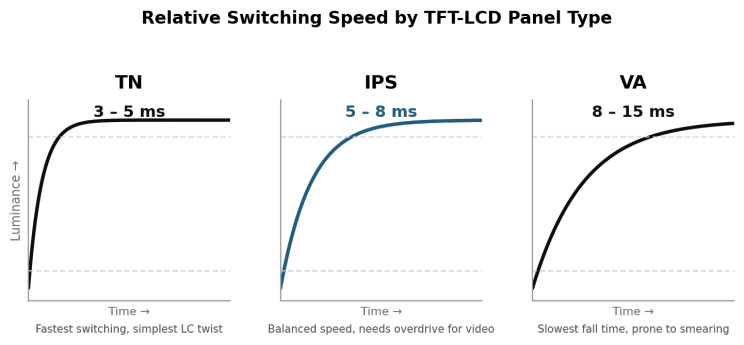
Many manufacturers compensate for slower native response with overdrive (RTC) — briefly over-driving the voltage beyond the target level to push the liquid crystal into position faster, then settling back. Used well, overdrive can make a VA or IPS panel feel nearly as responsive as TN; overdone, it introduces visible overshoot artifacts sometimes called "inverse ghosting."
Building a Product With Motion or Fast-Updating Content?
BIBA Electronics designs and supplies custom TFT-LCD and TFT display solutions across TN, IPS, and VA panel technologies, with full datasheets covering response time, contrast ratio, and viewing angle for every part we ship. As a dedicated TFT display manufacturer and supplier, we help engineering teams pick the right panel technology for video, scrolling UI, and other motion-sensitive applications — not just the fastest number on a spec sheet. Talk to our team about your display requirement.
Wrapping Up
Optical response time looks like a single number, but it's really a story about physics: liquid crystal molecules physically rotating into place, governed by viscosity and elasticity rather than instant electronic switching. Because rise and fall happen through different mechanisms, and because panel types align their crystals differently, response time varies a lot across TN, IPS, and VA technology.
Next time you're comparing response time specs from any TFT display manufacturer, remember: check whether the number is BWB or gray-to-gray, and whether overdrive is doing some of the work — the headline millisecond figure rarely tells the whole story on its own.
Frequently Asked Questions
What is optical response time in a TFT display?
Optical response time is the time a liquid crystal pixel takes to switch between brightness levels, usually measured as the sum of rise time (10% to 90% luminance) and fall time (90% to 10% luminance), expressed in milliseconds.
What is the difference between rise time and fall time?
Rise time is how long a pixel takes to go from dark to bright (10% to 90% luminance) after a voltage is applied. Fall time is how long it takes to relax back from bright to dark (90% to 10% luminance) once the voltage is removed. Fall time is often the slower of the two because it relies partly on the liquid crystal's natural elastic relaxation.
What is gray-to-gray (GtG) response time?
Gray-to-gray response time measures switching speed between intermediate gray levels rather than full black-to-white transitions. It is generally considered more representative of real video and motion content, since most on-screen transitions are not full black-white-black swings.
Which TFT-LCD panel type has the fastest response time?
TN (Twisted Nematic) panels typically have the fastest optical response time among TFT-LCD types, often in the 3 to 5 millisecond range, because their simple liquid crystal twist structure switches quickly. VA panels are usually the slowest, particularly on fall time.
Related Reading
- What Is Contrast Ratio, Really? A TFT Display Deep Dive
- What Is Viewing Angle, Really? A TFT Display Deep Dive
- What Is Brightness, Really? A TFT Display Deep Dive
About BIBA Electronics: BIBA Electronics is a TFT display manufacturer and TFT display supplier providing custom LCD and TFT panel solutions, technical datasheets, and engineering support for OEM and product design teams.
BIBA Electronics: electronics manufacturing, TFT displays and embedded design in Gurugram, India.