Handling TFT Displays the Right Way: A Practical Precautions Guide
Insights · 7 August 2026 · 7 min read · By Mr. Pratik Jhunjhunwala

ESD protection, safe cleaning, electrical cautions, and storage habits that keep a panel healthy.
A TFT-LCD module is a surprisingly delicate stack of thin glass, polarizing film, and static-sensitive driver circuitry, wrapped in a housing that makes it look far tougher than it is. Most field failures and warranty disputes that land on a TFT display supplier's desk trace back to handling, not manufacturing — a static discharge during assembly, the wrong cleaning solvent, or a module stored in the wrong conditions for too long.
As a display manufacturer shipping TFT-LCD modules every day, BIBA Electronics puts together handling guidance for nearly every customer integrating a panel into their product for the first time. Here's the practical version: what actually damages a module, and the habits that prevent it.
The Short Answer
Handling precautions exist because a TFT-LCD module has three distinct vulnerabilities: it's built from thin, crackable glass and a soft polarizer film; it runs on static-sensitive C-MOS driver circuitry; and its optical and electrical performance can be permanently degraded by the wrong cleaning agent, the wrong drive voltage, or the wrong storage environment. None of these are exotic risks — they're the same handful of mistakes that show up again and again across the industry.
ESD: The Damage You Don't See Happen
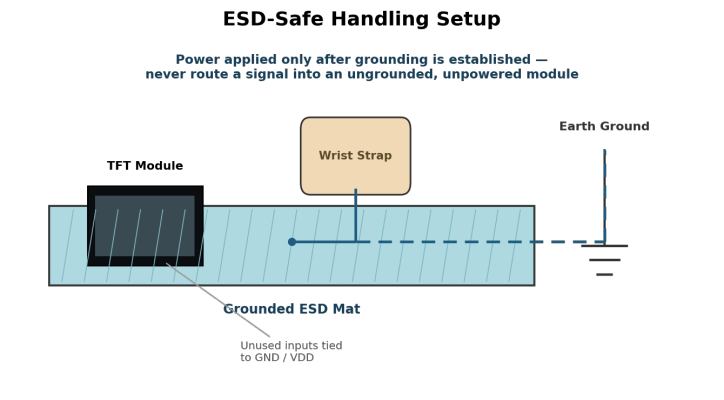
Electrostatic discharge is the precaution most often skipped, mostly because the damage isn't visible at the moment it happens. The driver ICs inside a TFT module are C-MOS circuits, and a static discharge well below what a person can feel is enough to degrade or destroy one.
The standard precautions are simple and well established in electronics assembly generally:
- Ground the operator (wrist strap) and the work surface (ESD mat) before the module is handled.
- Tie unused input pins to a defined voltage level rather than leaving them floating.
- Never apply an input signal to a module before its power supply is stable and established.
Cleaning and Physical Handling
The visible part of a TFT module — the glass and polarizer stack — is also the most fragile. The polarizer film scratches easily, and the ITO (indium tin oxide) bonding pads can corrode if the wrong chemicals get near them.
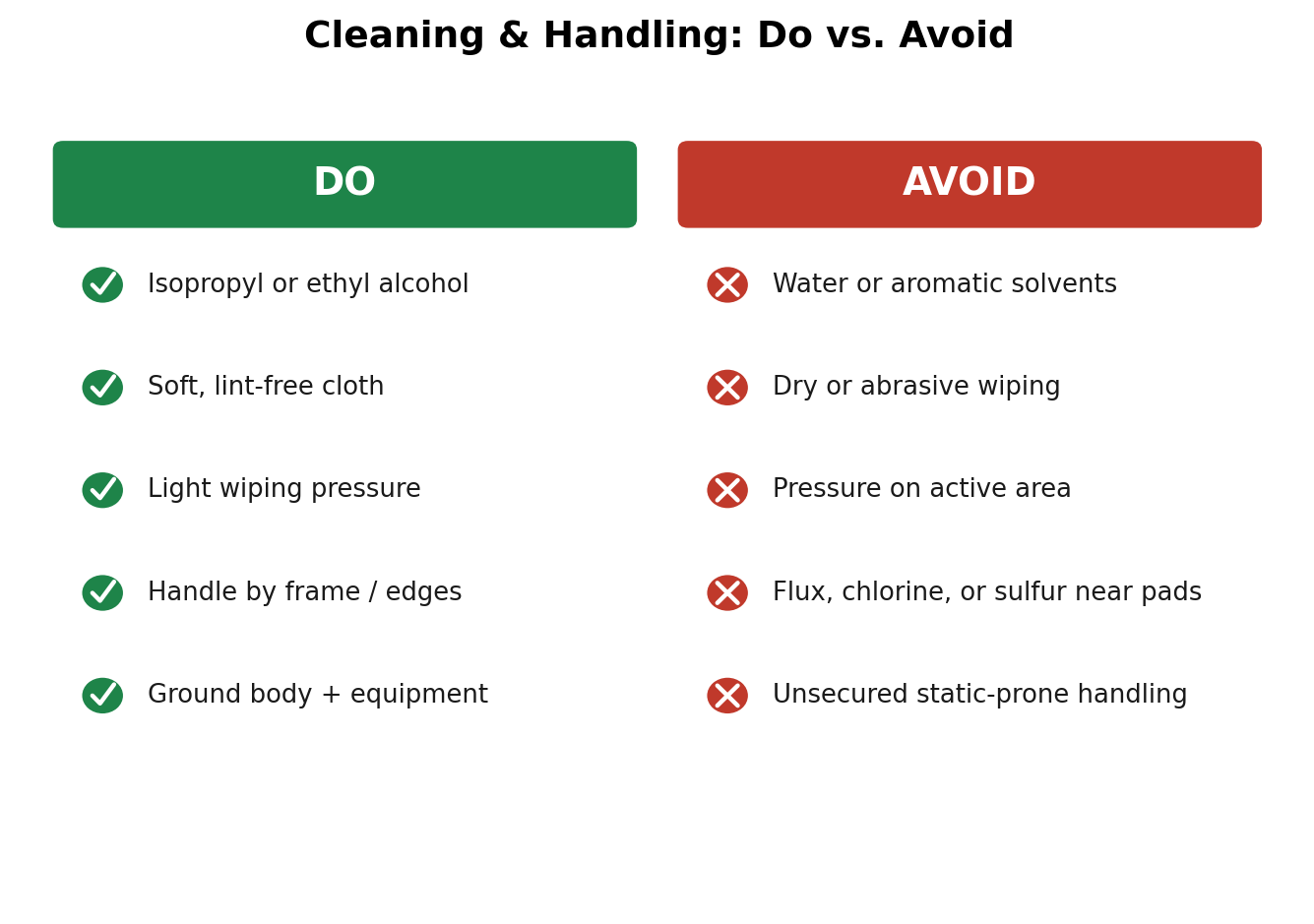
The safe approach is narrow on purpose: a soft, lint-free cloth, lightly dampened with isopropyl or ethyl alcohol, wiped gently across the display surface. Everything else on the list below is excluded for a specific reason — water and aromatic solvents can attack the polarizer, while flux, chlorine, and sulfur compounds can corrode the ITO pads over time, sometimes well after the module has already been assembled into a finished product.
| Do | Avoid |
|---|---|
| Isopropyl or ethyl alcohol | Water or aromatic solvents |
| Soft, lint-free cloth | Dry or abrasive wiping |
| Light wiping pressure | Pressure on the active area |
| Handle by the frame / edges | Flux, chlorine, or sulfur near the pads |
| Ground body and equipment | Unsecured, static-prone handling |
Electrical and Environmental Operating Cautions
A handful of operating cautions don't show up as obvious damage right away, but shorten a module's working life or cause display symptoms that look like defects but aren't:
- Stay within the rated supply voltage. Driving a panel above its specified voltage shortens liquid crystal life, sometimes significantly.
- Avoid sustained DC bias. A long-term direct current bias across the liquid crystal causes electrochemical degradation; LCD drive schemes are designed around AC switching for this reason.
- Expect response time and color shifts at temperature extremes. Liquid crystal responds more slowly in cold conditions and can appear darker at high temperatures — both are normal characteristics, not malfunctions, and resolve once the panel returns to its rated operating range.
- Keep humidity in check at operating temperature. Condensation on terminals can trigger electrochemical corrosion and lead to an open circuit over time, so relative humidity should be kept low, especially near the top of the rated temperature range.
Storage Best Practices
A module sitting in inventory for months still needs care. The standard recommendations for longer-term storage are straightforward:
| Practice | Why It Matters |
|---|---|
| Keep sealed in original packaging or a closed polyethylene bag | Limits exposure to fresh, humid air |
| Store in a dark location, out of direct sunlight | UV and heat exposure degrade polarizer and LC materials over time |
| Stay within the rated storage temperature range | Extreme temperatures can stress the glass and seal over long periods |
| Avoid any contact with the polarizer surface | The film scratches and dents easily, even through light packaging |
Bringing a New Display Into Production?
BIBA Electronics designs and supplies custom TFT-LCD and TFT display solutions with full handling, cleaning, and storage guidance documented for every part we ship. As a dedicated TFT display manufacturer and supplier, we work directly with customers' production and quality teams to make sure handling procedures are in place before a panel ever reaches the line — not after the first ESD-damaged unit shows up. Talk to our team about your display requirement.
Wrapping Up
Most TFT-LCD field problems aren't manufacturing defects at all — they're the predictable result of static discharge, the wrong cleaning solvent, an over-driven supply voltage, or months of storage in the wrong environment. None of the precautions here are complicated, but they only work if they're built into a process rather than left to individual judgment on the line.
Next time you're setting up a production or repair process involving a TFT display manufacturer's modules, build ESD grounding, approved cleaning materials, and storage conditions into the documented procedure from day one.
Frequently Asked Questions
Why are TFT-LCD modules sensitive to static electricity?
TFT-LCD modules use C-MOS LSI driver circuits, which can be damaged or destroyed by electrostatic discharge. Proper handling includes grounding the body and equipment, using a wrist strap, and tying unused input pins to a defined voltage level rather than leaving them floating.
Can you clean a TFT display with water?
No. Water and aromatic solvents can damage the polarizer surface and are not recommended for cleaning TFT-LCD displays. The standard recommendation is a soft, lint-free cloth lightly dampened with isopropyl or ethyl alcohol.
Why does a TFT display respond slower in cold temperatures?
Liquid crystal response time is temperature dependent. At lower temperatures, the liquid crystal becomes more viscous and switches more slowly, which is a normal characteristic of the technology rather than a defect. Response time recovers once the display returns to its specified operating temperature range.
How should TFT-LCD modules be stored long term?
For extended storage, modules should be kept sealed in their original packaging or a polyethylene bag to limit fresh air exchange, in a dark location away from direct sunlight, within the rated storage temperature range, and without any contact against the polarizer surface.
Related Reading
- What Is an Inspection Standard, Really? A TFT Display QA Guide
- What Is Optical Response Time, Really? A TFT Display Deep Dive
- What Is Brightness, Really? A TFT Display Deep Dive
About BIBA Electronics: BIBA Electronics is a TFT display manufacturer and TFT display supplier providing custom LCD and TFT panel solutions, technical datasheets, and engineering support for OEM and product design teams.
BIBA Electronics: electronics manufacturing, TFT displays and embedded design in Gurugram, India.