What Is an Inspection Standard, Really? A TFT Display QA Guide
Insights · 7 August 2026 · 8 min read · By Mr. Pratik Jhunjhunwala

Understanding AQL sampling, defect severity grades, and how a panel earns a passing grade before it ships.
Every TFT-LCD module that leaves a factory has already passed through a defined inspection process — but "passed inspection" doesn't mean "perfect." It means the panel fell within an agreed, documented set of tolerances. For anyone receiving modules from a TFT display supplier, understanding those tolerances is the difference between a normal cosmetic spec and a legitimate quality complaint.
As a display manufacturer shipping TFT-LCD modules every day, BIBA Electronics fields inspection questions constantly from customers reviewing incoming goods. Here's the breakdown: how inspection standards are structured, what AQL actually means, and how common defect types get classified.
The Short Answer
An inspection standard is the documented set of rules a TFT display manufacturer uses to decide whether a production lot is good enough to ship. Rather than inspecting every single unit, manufacturers pull a representative sample from each lot and check it against agreed defect definitions and quantity limits. If the sample passes, the lot ships; if it doesn't, the lot is reworked, sorted, or rejected.
The framework behind that sampling is called AQL — Acceptable Quality Level.
What AQL Actually Means
AQL = Maximum % Defective Considered Acceptable as a Process Average
Sampling plans built around standards such as ANSI/ASQ Z1.4 (the civilian successor to the well-known military standard MIL-STD-105E) define how many units to sample from a given lot size, and how many defects in that sample are acceptable before the lot is rejected. Crucially, AQL is not applied as one single number — it's applied separately to different severity grades of defect, because a dead panel and a faint cosmetic mark are not the same kind of problem.
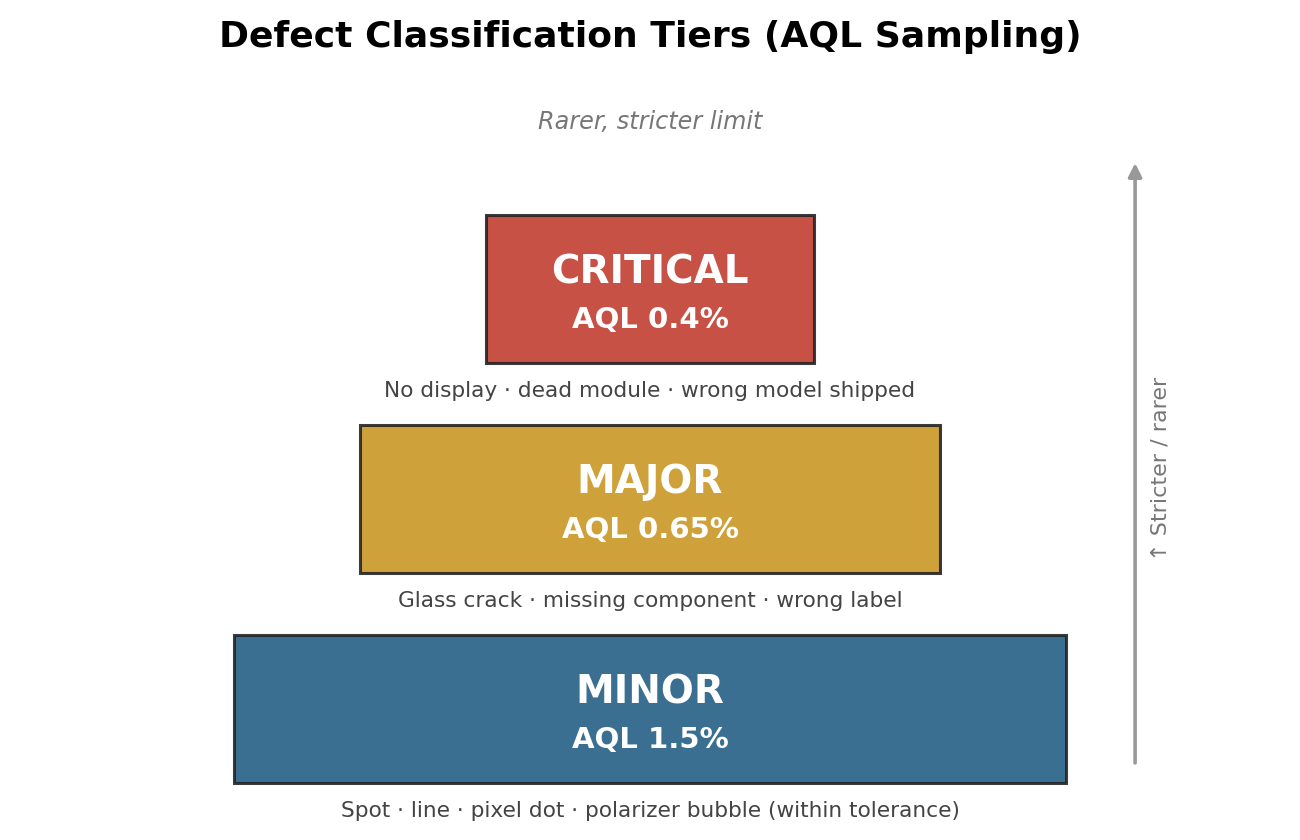
In practice, that usually breaks down into three tiers:
- Critical defects — problems that affect basic function: no display, a dead module, a short circuit, or the wrong model shipped entirely. These get the strictest AQL limit, often around 0.4%, because even a small number of failures here is a real functional problem.
- Major defects — problems that affect usability or correctness without being a total failure: a cracked glass, a missing connector, incorrect labeling. These typically sit around an AQL of 0.65%.
- Minor defects — cosmetic issues within a defined tolerance: small spots, faint lines, a handful of pixel dots, tiny polarizer bubbles. These carry the loosest limit, often around an AQL of 1.5%, because a certain amount of cosmetic variation is normal and expected in LCD manufacturing.
How Individual Defects Get Classified
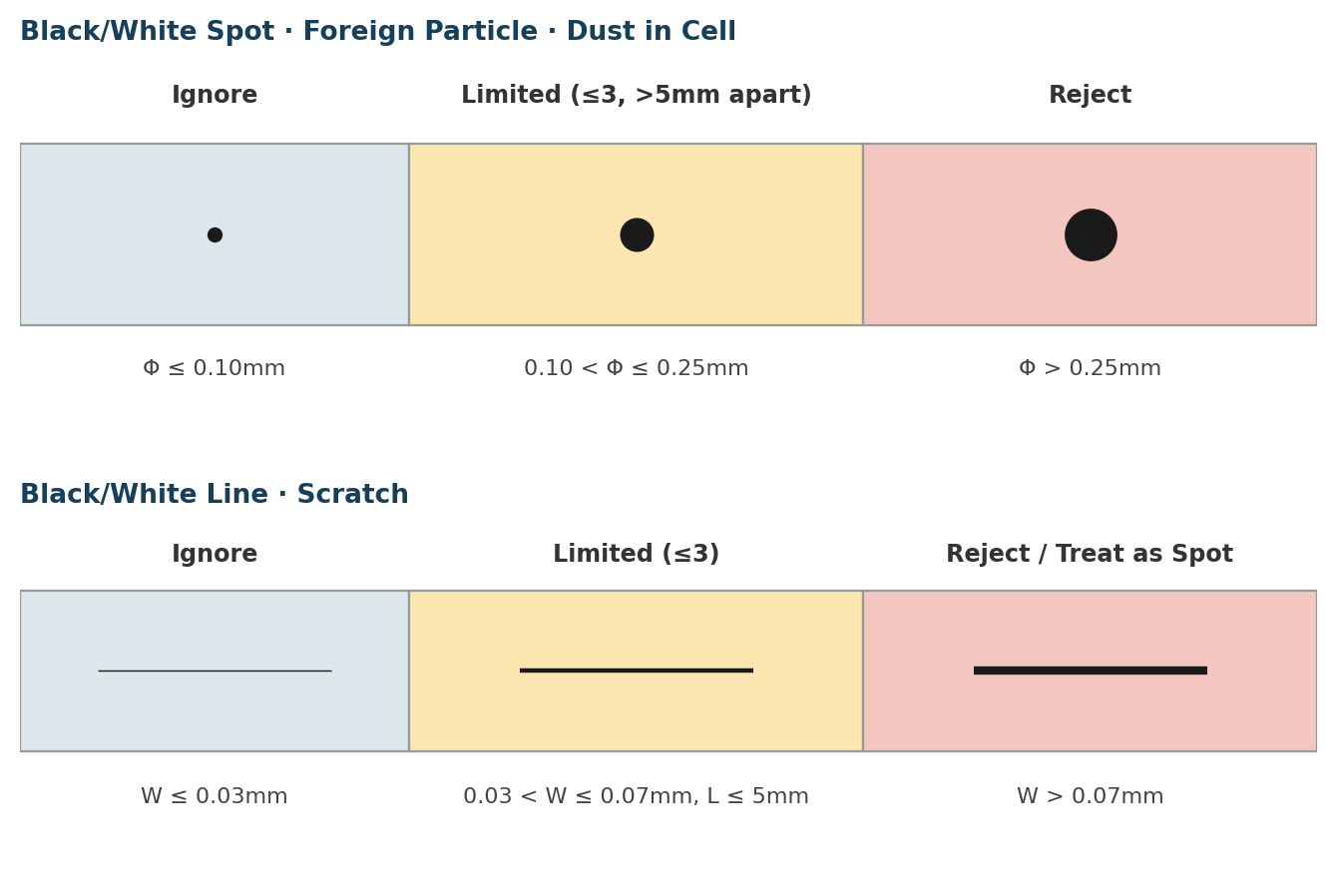
Underneath those three tiers, the inspection standard defines exactly what counts as a defect and how big it has to be before it matters. Two of the most common categories are spot defects and line defects, both judged primarily by size:
| Defect | Ignore | Limited | Reject |
|---|---|---|---|
| Spot (black/white spot, foreign particle, dust in cell) | Φ ≤ 0.10 mm | 0.10 < Φ ≤ 0.25 mm — up to 3, more than 5 mm apart | Φ > 0.25 mm |
| Line / scratch | W ≤ 0.03 mm | 0.03 < W ≤ 0.07 mm, L ≤ 5 mm — up to 3 | W > 0.07 mm (reject or treat as a spot) |
The figures above are a typical example — the exact limits for a given part are always the ones in its own datasheet and inspection sheet.
This same size-tiered logic extends to other common defect types found on most TFT-LCD inspection sheets:
- Bright dot / dark dot defects — a pixel or sub-pixel that's stuck on (bright dot) or stuck off (dark dot), checked under full black, white, red, green, and blue test screens. Most specifications allow a small number of each, as long as they're spaced well apart from one another.
- Polarizer bubbles or dents — small imperfections in the polarizing film, graded by diameter the same way spot defects are.
- Glass chipping — minor corner or edge chips are typically accepted up to a defined size, as long as the chip doesn't extend past the seal line or into the active display area.
Beyond Cosmetics: Reliability Testing
Inspection standards usually cover more than how a panel looks fresh out of the box. Reliability testing checks how it holds up over time and under stress, typically including:
| Test | Typical Condition |
|---|---|
| High / Low Temperature Storage | Extended exposure at the panel's rated storage temperature extremes |
| High / Low Temperature Operating | Extended powered operation at the panel's rated operating temperature extremes |
| Damp Proof (Humidity) | Extended exposure to elevated temperature and relative humidity |
| Vibration | Multi-axis vibration over a defined frequency range and duration |
| ESD | Repeated electrostatic discharge at a defined voltage and circuit model |
A module that looks flawless on day one but hasn't been validated against temperature cycling, humidity, vibration, and ESD is a different risk profile entirely — reliability data is just as much a part of a complete inspection standard as the cosmetic defect tables.
Reviewing Incoming Inspection Criteria for a New Display?
BIBA Electronics designs and supplies custom TFT-LCD and TFT display solutions with documented inspection standards covering AQL sampling, defect classification, and reliability test conditions for every part we ship. As a dedicated TFT display manufacturer and supplier, we work with customers' quality teams directly to align on acceptance criteria before volume production starts — not after a dispute over a shipment. Talk to our team about your display requirement.
Wrapping Up
An inspection standard isn't a guarantee of perfection — it's a documented, statistically grounded agreement about what "good enough to ship" means for a given product. Understanding the AQL tiers, how individual defects get sized and classified, and what reliability testing has actually been done turns a one-line spec sheet entry into something you can hold a supplier to.
Next time you're reviewing incoming modules from a TFT display manufacturer, remember: check which AQL grade a defect falls under before deciding whether it's actually a problem, and ask for the reliability test data alongside the cosmetic defect tables.
Frequently Asked Questions
What is AQL in TFT display inspection?
AQL stands for Acceptable Quality Level, the maximum percentage of defective units in a sample that can still be considered acceptable for a given defect severity grade. TFT-LCD modules are typically inspected using AQL sampling plans with separate, stricter limits for critical, major, and minor defects.
What is the difference between critical, major, and minor defects in a TFT display?
Critical defects affect basic function, such as no display or a dead module, and have the strictest AQL limit. Major defects affect usability or labeling, such as glass cracks or missing components, with a looser limit than critical. Minor defects are cosmetic issues within a defined tolerance, such as small spots, lines, or pixel dots, and carry the loosest AQL limit of the three.
What are bright dot and dark dot defects?
A bright dot defect is a pixel or sub-pixel that stays lit when it should be off, while a dark dot defect is a pixel or sub-pixel that stays off when it should be lit. Both are inspected under full black, white, red, green, and blue test patterns, and most TFT-LCD specifications allow a small number of each, as long as they are spaced apart from one another.
Why do TFT display manufacturers use sampling instead of inspecting every unit?
Sampling plans based on standards such as ANSI/ASQ Z1.4 or MIL-STD-105E allow manufacturers to make a statistically sound accept or reject decision for an entire production lot by inspecting a representative sample, rather than every unit. This keeps inspection practical at production volume while still controlling defect rates within agreed AQL limits.
Related Reading
- Handling TFT Displays the Right Way: A Practical Precautions Guide
- What Is Contrast Ratio, Really? A TFT Display Deep Dive
- What Is Brightness, Really? A TFT Display Deep Dive
About BIBA Electronics: BIBA Electronics is a TFT display manufacturer and TFT display supplier providing custom LCD and TFT panel solutions, technical datasheets, and engineering support for OEM and product design teams.
BIBA Electronics: electronics manufacturing, TFT displays and embedded design in Gurugram, India.